Saturday, April 19, 2008

Dier Mar Musa El-Habashi

We left Damascus 7:00 a.m. on Friday morning heading towards the Deir Mar Musa El-Habashi Monastery via the small town of Nebek.


We took a taxi to catch a minibus at the minibus station. When we got to the minibus station, some ‘hoodlum-looking’ men kept insisting that they check our knapsacks and passports. After some ‘debating’ with those ‘hoodlum-looking’ men, we discovered that they were the Police. Then they needed to give us some ‘clearance’. So one of them told the other one to write something on a piece of paper, which they haphazardly found on a desk. Finally, with our ‘clearance’ piece of paper, we were ready to get on the bus with our two knapsacks and too many people for the 12-seater bus. However, everyone is very accommodating, rearranging us and our knapsacks and we were off on a two-hour trip to Nebek. Being the last people on the bus, the driver offered to drive us to the Monastery for 2SYP ($4.00), rather than having to catch a taxi for the final distance.


The website describes the monastery:
The monastery seen from belowThe ancient Syrian monastery of St. Moses the Abyssinian (Deir Mar Musa el-Habashi) overlooks a harsh valley in the mountains east of the small town of Nebek, 80 km north of Damascus, and about 1320 metres above sea level. A monastery on the top of a mountain in the middle of the desert. 6 christian monks and 2 nuns stay here, and welcomes all kind of visitors. Interfaith dialogue is important here. The new foundation of the monastic community started in 1991. On a social level, the community of Deir Mar Musa works to develop services which facilitate inter-cultural and inter-religious dialogue and harmony.


We arrived at the Monastery, around 9:00 a.m. ready to climb up the stairs and path (with our knapsacks) about 1320 metres above sea level. It took us an hour. The ancient Syrain monastery of St. Moses the Abyssinian (Dier Mar Musa el-Habashi) overlooks a harsh valley in the mountains east of the small town of Nebeck, 80 km north of Damascus. It is quite the sight to come to.


The website says:
Walking: Walk into the mountains east of Nebek until you see a cottage surrounded by a garden. On the path beneath it there is a large stone garage and from this point the way to Deir Mar Musa is marked on the rocks with splodges of red paint. Please be careful of walking this way in winter. The path follows the route of an ancient river and can be very slippery. In summer it is necessary to carry a large amount of water with you. At all times it is advisable to carry a stick to discourage the sheep dogs that roam semi-feral in the area.


Upon our arrival, when asked how long we planned to stay, we let the workers know that we would be staying overnight. They then showed me to the Women’s old section of the Monastery and Gerald to the Men’s section. My room was on the second level (top) of the Women’s Building. This section contained approximately five rooms off a large, long room. Each room had a cot and a light switch (thank goodness). The walls were made of stone, as was the floor. However, we were given bed sheets and there were many blankets, as it gets very cold in the night. (We did not need to bring sleeping bags.)


Upon our arrival, we were served a huge breakfast around 10:00 a.m. Then we were fed another huge lunch at 2:00 p.m. All that eating, inspired us to take a hike in the mountains behind the Monastery to see the caves of the hermits that use to live in the mountains. After some two hours of climbing and following paths, we realized that we were ‘off the path’. This was of some concern as it would be getting dark in a couple of hours.


(We had also heard stories about wild dogs.) We decided to create our own path as we could see where we needed to go. We followed a goats’ path down the side of the mountain and luckily it led to the back door of the new Women’s building.


At 7:00 p.m. there was a Catholic Mass at the church of the Monastery. The monastic church was built in 1058AD according to the Arabic inscriptions on the walls. The frescoes in the church date from the 11th and 12th centuries. Initially, there was a short service, followed by an hour of silence as we sat in Arabic style (i.e., on a carpeted floor). The church was lit by candles only. The service was in Arabic. It was magical. Following the hour of silence, there was a Communion Mass in which communion was passed around versus having to go to the front of the altar.


Following the services, we had supper at around 10:00 p.m., outside, under the stars in the desert, high above ‘in the clouds’ it seemed.


The next morning – this morning – we left the Monastery at 7:00 a.m. It took us only a half an hour to get ‘back down’. Luckily for us, two young women, who worked there, were also leaving for the day, today, so we were able to get a ride back to Nebek with them. We caught a bus in Nebek to Palmyra, where we are currently.

Touring through Damascus

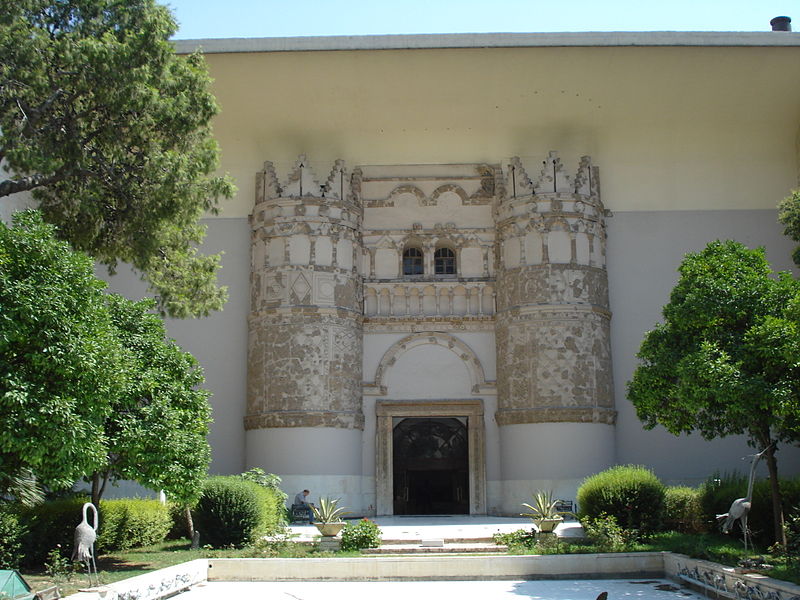
Outside space of National Museum --


Inside could not take pictures of:

hypogeum, which is a construction of an underground burial chamber from the valley of the Tombs at Palmyra; the fresco-covered synaagogue recovered from Dura Duropos;and rock indicating the beginning of an alphabet some 4,000 years ago


5. the Azem Palace, built in 1749 by the governor of Damascus. It is fashioned in the typical Damascene style of striped stonework, which is achieved by alternating layers of black basalt and limestone. The rooms of the palace are decorated with inlaid tile work and painted ceilings.


Inside the palace, we saw utensils used and clothing from Damascus and nearby areas, which differed.

6. Inner courtyard of Umayyad Mosque. It was converted Byzantine cathedral. The mosque was built in AD 705. The outstanding feature of the mosque is its golden mosaics, which adorn several of the facades around the central courtyard.


MaryIris had to go to the 'Special Clothes Room", which women are required to don the grey robes supplied prior to going into the Mosque if it was felt that they were not properly attired, in addition to taking off our shoes.


7. MaryIris in Inner Courtyard of Mosque at the place where you wash yourself to prepare to pray. i.e., making yourself clean to enter to holy place and pray. There is a specific procedure of washing, i.e., face first, then arms, then feet.


8. The Inner Mosque. After walking in the centre for some time, we realized that women are on one side and men on the other side of the Mosque. Inside there was a tomb, where people prayed and put in pictures of loved ones.


9. Picture of a typical breakfast in Syria, except for the eggs that we requested. Breakfast consisted of: a bean/yogurt/tomato mixture, a huge, huge, huge piece of pita-like bread that is place on the table and a bowl of pickles, pickled peppers and some other vegetable that we think was turnip. We had tea, because they did not have coffee. The total cost of the two of us was 1.5 SYP ($3.00). Much more within our budget.


10. Typical street scene in Damascus, i.e., Mosque in background, many, many, many, yellow taxis everywhere. The streets were initially quiet as today is a holiday, i.e., Independence Day for Syria, so many people got a late start.


11. Remains of a Roman Arch at the beginning of the Christian quarter. Historically known as Straight Street (Via Recta). St. Paul Chapel on the street marks the spot where, according to the biblical tale, the disciples lowered St. Paul out of a window in a basket one night so that he could flee the Jews. The old cellar of the Chapel of Ananias (Sharia Hanania is reputed to be the house of Ananias, an early Christian disciple).


We spent yesterday in the souks and on the streets in Damascus drinking 'hospitality' tea and Turkish and Syrian coffee and negotiating prices for things. Damascus is one of the most architecturally significant cities in the Middle East and the souks certainly attest to the grandeur of the past. Yesterday was Easter Sunday for Christians. Consequently, many people were on holidays and the souks were very crowded.

During our day we took 'breaks' to get a cup of tea (everyone drinks tea all the time), or have some humus with meat. Some of the restaurants in the souks are wonderful experiences. They are very old and have very high ceilings, very old lanterns and chandelies and marble floors in various design patterns. The services is always exceptional and the cost minimal (which is an added bonus).

Pictures from Damascus

Hookah - an oriental tobacco pipe with a long flexible tube connected to a container where the smoke is cooled by passing through water; Gerald smoking waterpipe at hotel -- apple-flavoured;


The first place we approached was booked. The second place had one room left, which we took at 900 SYP ($18.00), which is more our budget. The hotel has a beautiful courtyard inside featuring trailing vines, an orange tree and a central fountain. The floors and walls are ceramics. The house is a few hundred years old. The person at the desk is 96 years old and he is the official welcomer, inviting you to come and enjoy the courtyard.

2. Inner courtyard of hotel;


3. Inner courtyard of hotel.

Wednesday, April 16, 2008

To damascas

We left Karak on Tuesday morning around 8:00 a.m. Our hotel person told us that no one is up at 5:00 a.m. to get a bus. He promised us breakfast if we got up at 7:00 a.m. -- so we did. The walk all the way down to the main highway was gruelling with our knapsacks on because it was so steep.


We arrived back at Amman at 10:00 am. We took a taxi to another bus station to catch the next bus to Damascus. Finding out that the next bus for Damascus left at 3:00 p.m., and thinking our journey would be seven hours, we did not want to get into the city that late. So, we took a service taxi, with two other persons, and left within a half hour -- this cost us $4.00 more than the bus would have.


In hindsight, the service taxi was the better option for crossing the border from Jordan into Syria. Our taxi driver was helpful in rushing us through the four/five checkpoints at the border to get us through quickly.


Everytime, we would get into the car and sit down, the taxi driver would drive a few metres and then motioned us to get our passports out AGAIN. When I would ask AGAIN, he would nod his head. It WAS Like the Amazing Race. I think it was also helpful that we went to the VIP/Diplomats Line as the Foreigners Line seemed somewhat derogatory.


When we arrived at the outskirts of Damascus, the Service Taxi Driver DROPPED us off literally and one of the other persons with us (who spoke no English). We were all somewhat puzzled about where we were. However, the Driver, kept motioning to us to get our luggage out of the car -- so we did. Yes, language can be somewhat of a barrier.


So, we proceeded to get a Yellow city taxi, which promptly appeared -- surprise, surprise. Luckily, the Yellow City Taxi knew exactly the area we wanted to go to. He was indeed, a good driver, given the amount of traffic as we got closer to the City Centre. We have discovered that cars do not signal, they beep while they are proceeding.


We were somewhat concerned as we had read that we should have reserved in advance as this is high season for travelling in Syria.


The location of the hotel is perfect as it is close the the National Museum and the old City.


Monday, April 14, 2008

Aqaba

After leaving Wadi Rum at 6:30 a.m. on Saturday, April 12th, we proceeded to Jordan's
aquatic playground, the city of Aqaba on the Gulf of Aqaba, almost the most southern point of Jordan. Aqaba is famous for its diving and snorkelling because of the coral reefs and the varieties of fish in this particular area. Aqaba attracts visitors from across Jordan and Saudi Arabia.


The late King Hussein's family has a retreat in Aqaba (according to Queen Noor in the book, Leap of Faith,

which I am currently reading). I suspect that his son Abdullah II visits in Aqaba often. I also suspect that we will not be seeing his home this time.

It was in Aqaba we realized that the stores close from 2:00 to 5:00 p.m. in the day for 'lunch'. I suspect that this has something to do with the scorching heat we were experiencing during the day in Aqaba.

While in Aqaba we visited the ruins of a Crusader castle and a nearby Museum.


We also participated in the atmosphere of a 'beach city', complete with a very active night life of many people visiting the town's hotspots.

The hotel we stayed in was in the middle of the hustle, bustle of the town. Initially, when we found our hotel room for 19 J.D. ($28.00) we thought that the air conditioning and fan in the room were somewhat 'overkill'. It did not take long for us to realize that these options were valuable. We were able to minimize our use of the airconditiong and fan by leaving our balcony door open during the evening allowing the breeze to cool the room and to be lulled to sleep by the coastal revellers which we could observe from our very large balcony. We could also wash some clothes and hang them out to dry within hours. There were many interesting restaurants, nut, gold, watch shops in the town to explore.

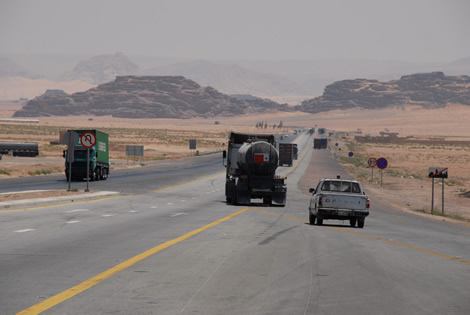
This morning we caught the minibus at 7:00 a.m. to begin our journey north towards Syria. We arrive in Karak at 11:00 a.m. On the way to Karak the landscape was very dry and rocky for miles without any green in sight, only the occasional Bedouin home.


We were stopped at check points three times. We did not take a picture of the Toyota truck with a rifle mounted on the roof, with a solider ready to shoot, if necessary. We did not feel it would be an appropriate gesture on our part. The locals knew exactly what to do each time i.e., show their cards and we followed suit by showing our passports.

In Karak, we found a nice room for 16 J.D. ($23.00) in an old hotel called Towers Castle with breakfast. Our bathroom is huge, huge. After settling into the room, we proceeded into town to find some food to eat. This is always an adventure because we like to eat where the locals eat. This afternoon we found a restaurant and ordered one lunch plate. Our lunch plate for one consisted of so much food that we wrapped some of it to take away for supper.


This afternoon we visited the ancient Crusader castle of Karak. It became a place of legend during the 12-century battles between the Crusaders and the Muslim armies of Saladin. This castle is among the most famous of the castles built by the Crusaders stretching from Aqaba in the south to Turkey in the north.


The fortifications of the castle still dominate the modern walled town of Karak. The vastness of space that the castle occupies, the height of the walls and stone structures and the complexity of the buildings is breath-taking.


This afternoon we also investigated our options for leaving tomorrow towards Damascus. We were told the bus leaves at 5:00 a.m. However, since there does not appear to be a 'formal' bus station' we are not certain whether this is reliable information or not. We will need to explore this more this evening.

Saturday, April 12, 2008

We were planning to leave Wadi Musa on Thursday morning for Wadi Rum. The bus was scheduled to leave at 6:30 a.m.,which is definitely not holiday time. However, our kind hotel person, William, was able to arrange a ride for us with two other couples from France who were leaving for Wadi Rum at 8:30 a.m., a much more civilized time.


We arrived in Wadi Rum around 10:OO a.m. and looked up the guide that William had recommended. We found Sabat-eit at the Visitors Centre and he explained the various options of exploring Wadi Rum. We decided that we would begin our tour the next day, as this day there was a sand storm in the desert and it would have been difficult to see the various sites or trek in the desert.


Sabat-eit invited us to stay in his home for the night, as his wife and family were away visiting her mother, who lives in the desert permanently. (The mother lost her husband some two years ago and has been very lonely since.) Staying at Sabat-eit's home in the Village was quite the experience. We slept in the room, with no roof, so that we could see the stars in the sky.

Wadi Rum, is described as a Desert of Mountains. It was described by Lawrence of Arabia as 'vast and echoing'. The landscape consists of sheer-sided mountains of sandstone and granite emerging from open vallyes to reach heights of over 1700 meters, and narrow canyons cut deep into the mountains, often concealing ancient rock drawings. It is now a protected area covering 720 square km.


The area was made famous by the Arab revolt and TE Lawrence in the early 20th century and by the film Lawrence of Arabia, which was partly filmed here. It is quite spectacular with its flat red desert sand and its majestic rocks.

We began our exploration of the Desert with the Nabatean Temple - Aretas (IV) used by Nabatean to worship ALLAT (Godess). this temple was builton the ruins of Allat temple of the AAD Tribe. The same Nabateans that built Petra.


Exploring Wadi Rum, we saw sand dunes that reminded us of the dunes at the Pinery, the difference being red sand and much higher in height. We climbed a deep, narrow fissure in the mountain side, containing many rock inscriptions in the Khazali canyon.
We also saw Anfashieh inscriptions of drawings of animals, humans, and camel caravans and Alameleh inscriptions.


We also saw spectacular natural rock arches, with great views.


After viewing some of these sites,we went to visit Sabat-eit's wife and mother in the desert. Before lunch,two of their children, a girl, who was 11 years old and a boy, who was 8 years old took us for a hike and some mountain climbing into the desert in the Burrah canyon. As we walked along in our hiking boots, they walked along in their flip flops, only to remove them when they encountered some steep, difficult climbs. After our walk, Sabat-eit's wife made lunch for us. Then we had a leisurely nap during the heat of the day.


That evening we saw the sunset from a viewpoint of one of the mountains in the Desert. We stayed at a permanet camp site appropriately named Sunset Camp. Supper was delicious. We slept in traditional Bedouin tents after looking at the star-filled sky and feeling the quiet of the desert in the evening as it cools down.


The next morning we were up at 5:45 a.m. for a quick breakfast before our ride back to Wadi Rum Village to catch the only bus to Aqaba for the day. . The truck of choice for the desert terrain appears to be Toyotas. Our driver drove as quickly as he could given the distance and time constraint to get us to the minibus leaving for Aqaba at 7:00 a.m.


Wednesday, April 9, 2008

Day 4

This morning at 8:00 a.m. we were at the gate to get into Petra. The approach to Petra is through an incredibly narrow 1.2km-long passage known as the siq.


This is not a canyon, but rather one block that has been separated apart by tectonic forces. Just as you start to think there is no end to the siq, you catch breath-taking glimpes of the most impressive of Petra's sights, the Khazneh (Treasury).


The Treasury is carved out of iron-laden sandstone. The Greek-style pillars and alcoves are masterpieces. as you walk along you come to the street of facades, the
hightlight of which is the weather-worn 7000-seat theatre. The Royal Tombs are breathtaking as are the mountains in which they are situated.

We walked along streets, walkways in various states of restoration, looking up at tombs in the mountains, etc. for five km. to a 800-step winding path into the mountains and came upon the Monastery, another spectacular carving in the side of the mountain.


We spend the day until 4:30 p.m. walking, climbing, enjoying the "Wonder". We were able to climb up to the top of the mountain and see various paths going through the mountains to other places.

We had to hurry because we had booked ourselves a Turkish Bath for the end of today. We were steamed, exfoliated, soaped, massaged and served tea, for $30.00 U.s. each. What a deal. We were both so happy we decided to do this as it did rejuvenate us for the evening.